One position, three representations.
Everything starts with how the position is stored. The same board can be a piece list, a square-centric mailbox, or twelve 64-bit bitboards — each makes different questions cheap. These views track the live board below.
In the book — Part One derives all three representations — and when each one wins.
Try Flip to Bitboards, then run the step-by-step generator below.
Every legal move, and nothing else.
Click a piece to see its legal moves — castling, en passant, promotions, pins, and checks all handled. This board is the source position for the live stations on this page.
In the book — Two chapters build this generator rule by rule: pins, en passant, castling and all.
Try Castle both ways from the start position · promote a pawn on Position 4.
Moves played
Legal moves here: —
Prove the move generator.
Perft walks every legal move sequence to a fixed depth and counts the leaves. One wrong castling rule, one missed en-passant pin, and the totals diverge — every move generator in this book must prove it. Known reference values are checked automatically.
In the book — The book treats these tables as law — every move generator must reproduce them exactly.
Try Depth 5 on the start position — 4,865,609 nodes, checked live.
Watch alpha-beta throw work away.
Minimax visits everything; alpha-beta proves most of it irrelevant. Step through the abstract tree, then run both searches on the real board position and compare the node counts.
In the book — Search gets four chapters: windows, ordering, and why the pruning is free.
Try Depth 4 on Kiwipete, then compare the node bars.
The same position, reached twice, searched once.
Different move orders reach identical positions. A Zobrist hash names each position in one 64-bit number, and a transposition table lets the search recognize work it has already done.
In the book — Zobrist hashing, table bounds, and the subtle bugs they cause have a chapter of their own.
Try Show a transposition, then search with the table on.
Play a move on the board and this hash changes; return to the same position by a different move order and it comes back exactly.
Never evaluate in the middle of a capture.
A fixed-depth search stops mid-exchange and believes the material it just grabbed is free — the horizon effect. Quiescence search keeps resolving captures before trusting the evaluation.
In the book — The horizon effect and its cure, with worked traces from a real engine.
Try Load the horizon position and watch depth 2 pick the wrong capture.
What the engine thinks a square is worth.
The classical evaluation is material plus piece-square tables: a knight on the rim is worth less than a knight in the center before any search happens. Pick a piece to see its table — and play a move on the board here to watch the bar react.
In the book — From these tables to a full evaluation, term by measured term.
Try The knight’s table — rim against center.
Greener = bonus, redder = penalty, from White’s side.
Centipawns from White’s perspective — +100 ≈ one pawn ahead: the signal a GUI evaluation bar shows, before any search. This is the same live game as the main board — move a piece and the bar reacts.
Speak the protocol every GUI understands.
An engine is a program that reads lines and writes lines. This is a real UCI session against this page’s own small engine — click a command to send it and read the reply.
In the book — The complete protocol, one responsive worker, and a GUI-ready engine.
Try position startpos moves e2e4 e7e5, then go depth 3 — the engine answers with its search and best move.
Is the new version actually stronger?
A faster program is not a stronger engine, and a won match is not proof. SPRT plays paired games with colors swapped, buckets the pairs into five outcomes, and stops exactly when the evidence crosses a bound. Set the true strength difference and watch the test decide.
In the book — Fixed-work benchmarks, paired openings, SPRT — measurement without mythology.
Try Set +2 Elo and watch how long the test refuses to decide.
Evaluation as a network you update, not recompute.
NNUE’s trick is incremental: a move changes a handful of input features, so the first layer’s sums are patched rather than rebuilt. Play moves on the board and watch which accumulator values change.
In the book — The architecture, the data contracts, and the training roadmap — honestly scoped.
Try Castle on the main board — four features flip at once.
Search guided by belief, refined by visits.
AlphaZero-style search: a prior policy suggests moves, a value estimate scores leaves, and visit counts concentrate on what keeps proving good. Run playouts on the live board position.
In the book — Policy, value, and search united: the AlphaZero design, in engine terms.
Try +500 playouts, then read the visit distribution.
Games are data.
FEN names a position; PGN records a game. Anatomy of the live position’s FEN below, and a PGN replayer loaded with Morphy’s Opera Game — paste any game to step through it.
In the book — Databases, PGN tooling, and analysis software fill the book’s closing part.
Try Step to the end of the Opera Game.
Tactics, verified by the engine.
Eight engine-verified mates. Find the move on the puzzle board — the same move generator that passed perft judges your answer.
In the book — The closing chapters show how to mine and verify tactics from real games.
Try Puzzle 6 is a smothered mate.
See what a position says.
The book closes with software that shows chess rather than plays it. Attack maps of the live position: every square colored by who controls it. The board is live — move a piece and watch the map redraw.
In the book — The closing chapters build this analysis software in full — where the book ends.
Try Contested control after 1.e4 e5.
Only in the book.
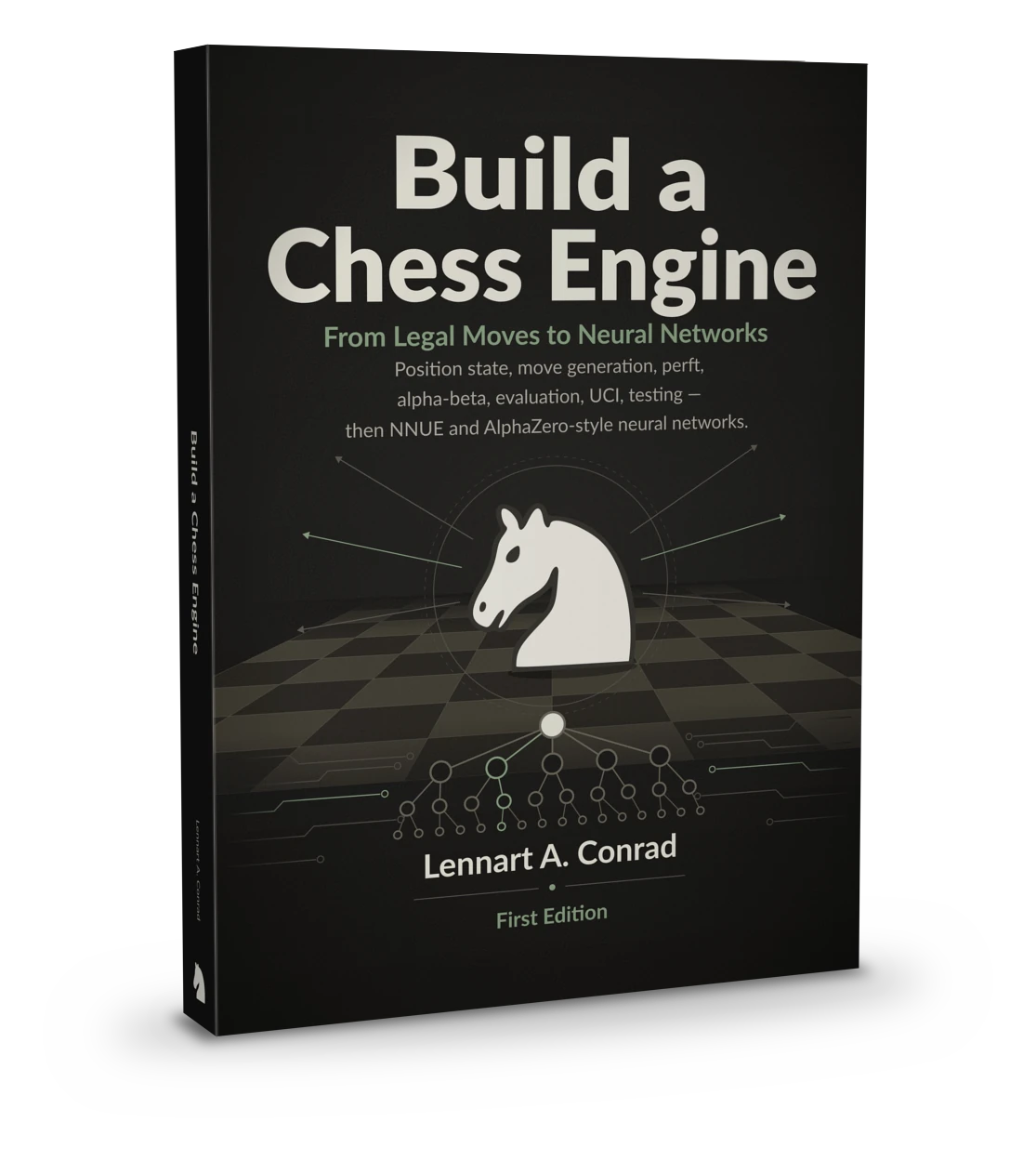
This page shows the algorithms moving. The book is where they are built — 442 pages, every subsystem derived, tested, and measured. None of the following is on this site:
- The complete derivations — every mask, every invariant, every edge case, with the reasoning
- Make/unmake, state snapshots, and the reversibility discipline that makes engines debuggable
- Bug Laboratories: broken engines to diagnose, with worked diagnostic traces
- Move ordering, iterative deepening, time management, and the clock that never loses on time
- A UCI engine built around a responsive worker — GUI-ready, release-packaged
- Fixed-work benchmarks, paired openings, confidence intervals — the full measurement discipline
- Janus case studies from a real engine, including the ideas that failed or stayed inconclusive
- NNUE and policy-value MCTS as implementation roadmaps: architectures, data contracts, training pipeline
- Databases, opening explorers, annotation, puzzle mining, and chess-software products
- Predict exercises throughout, plus a separate answers workbook