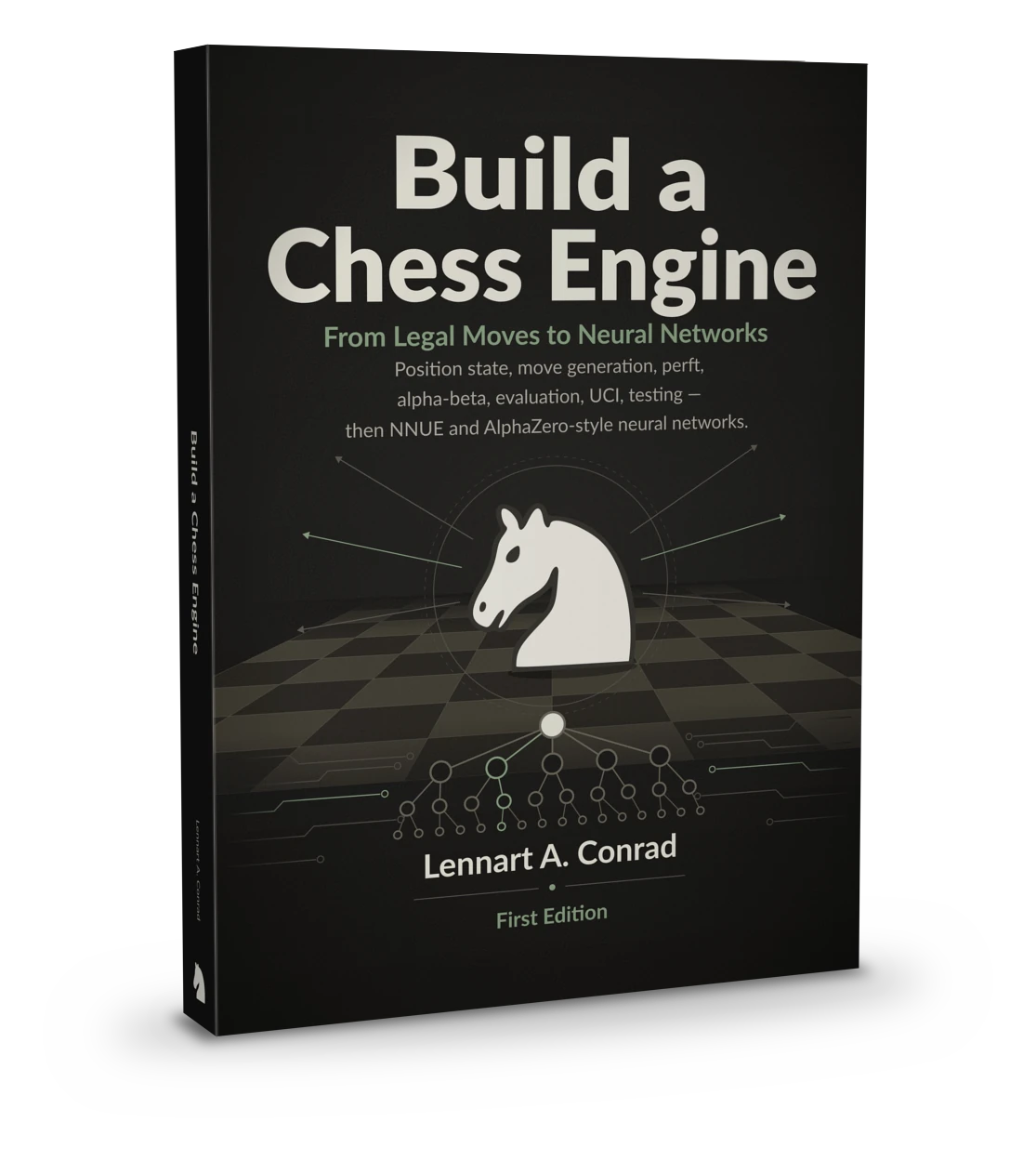
One complete book. Three formats.
Every edition contains the same complete book — the engine course, the Beyond the Engine software-project part, and the appendices. The difference is format only. Scan a code or follow the link to the Amazon listing.
The same book in full color on screen. Reflowable Kindle edition with live cross-references and links.

The complete book at the lowest print cost. Black-and-white interior on crisp white paper, 8.5″ × 11″.

The full semantic color system in a durable case-laminate format. Premium color interior, 8.25″ × 11″.

Links open the Amazon.com listing; each edition is also available on Amazon’s international marketplaces.
An engine you can trust, end to end.
By the classical stopping point, your engine can…
- replay legal positions and play complete games
- find mate and return deterministic fixed-work results
- survive full-state and perft checks
- stop before a hard deadline, every time
- speak UCI through one responsive worker
- run controlled, paired engine matches
- package a known-good release
From first principles to modern architecture.
Correctness before speed
Every subsystem gets a simple required path and a specific oracle. You do not optimize an engine whose state you cannot restore.
Diagnosis, not answer dumping
Predict exercises, focused fixtures, and Bug Laboratories teach you to turn one bad total or protocol symptom into one violated invariant.
Measurement without mythology
Fixed-work benchmarks, paired openings, confidence intervals, and SPRT distinguish a faster program from a stronger engine — and a real improvement from noise.
Modern architecture with honest boundaries
NNUE, policy-value MCTS, self-play, and hybrid designs connect to the classical engine through explicit data and inference contracts.
Experience converted into decisions
Janus case studies show what was tested, what happened, and what to generalize. Failed and inconclusive results stay failed and inconclusive.
The algorithms, running in your browser.
A free interactive companion: play the engine, watch alpha-beta prune a real search tree, step through bitboard move generation, verify perft counts against the book’s tables, and run an SPRT test yourself. A taste of every part of the book — the derivations live in the book.
Open the interactive companion →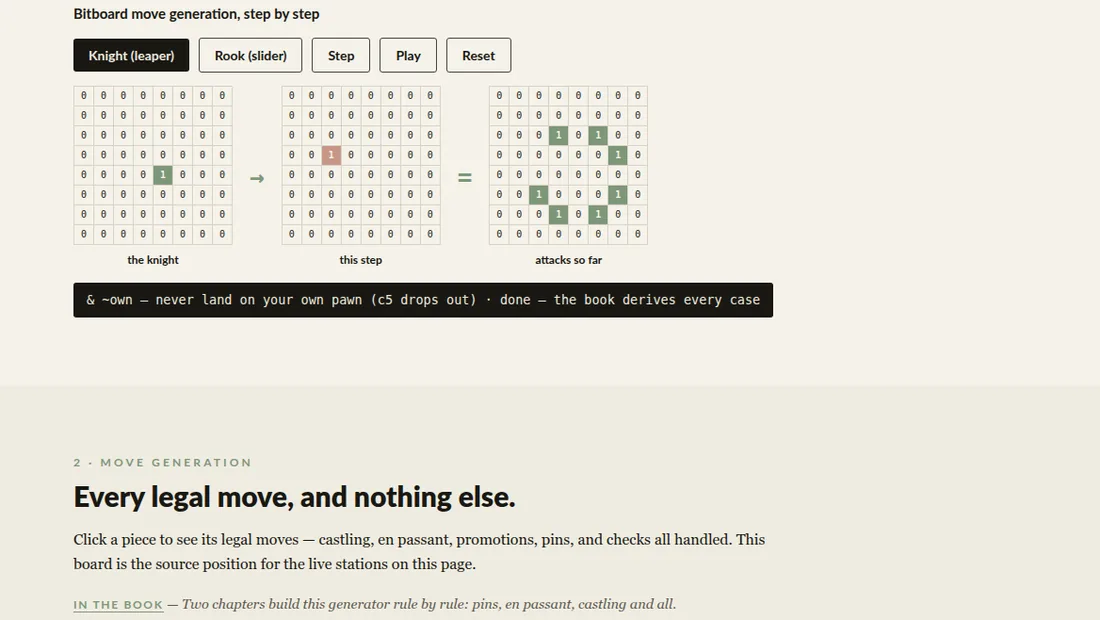
Programmers who finish projects.
You should know the rules of chess and be comfortable with functions, arrays or structs, loops, recursion, and tests. You do not need to be a strong chess player or know bitboards in advance.
Examples are language-neutral, with implementation notes for Rust, C++, Python, and other common choices.
Lennart A. Conrad
Lennart A. Conrad is the developer of Janus, a Rust chess engine. Chess programming was how he learned to program in practice: an early playing application grew into chess-data and puzzle tools, a Java engine, and eventually Janus.
His work on Janus connects rule correctness, search, evaluation, profiling, protocol design, controlled engine matches, and neural inference. Just as important, it records ideas that failed, measured no effect, or needed better evidence. That experience shapes Build a Chess Engine: begin with one simple correct path, make every state transition reversible, use tests that localize mistakes, and earn complexity through measurement.

More of the author’s chess software is open source — including the deterministic toolkit that generated this book’s diagrams.